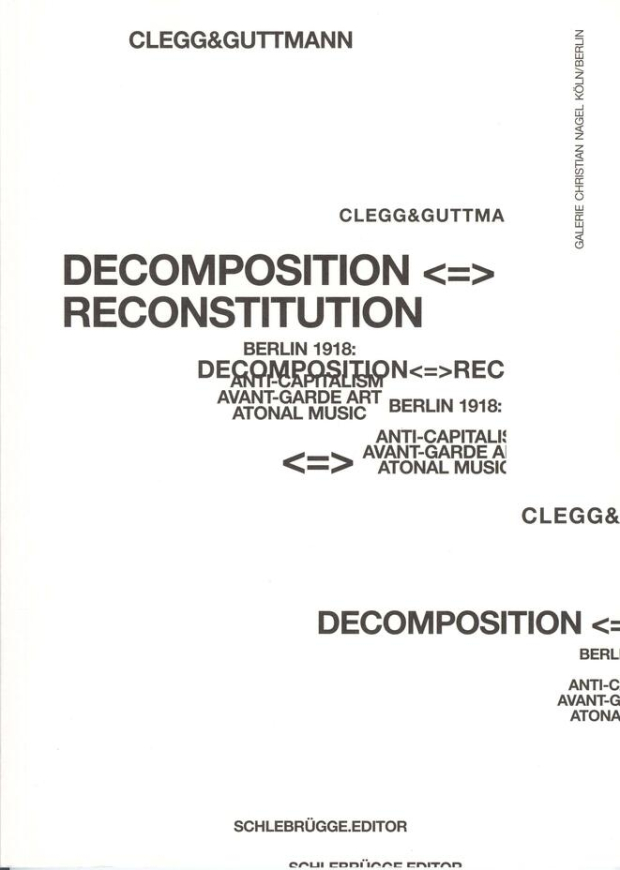
In 2003, Clegg & Guttmann discover a constellation in Berlin that is unheard of in the history of modernism and actualize the energies of this discovery for a renewal of the aesthetic and political perception of this city: it is about the few years after the First World War, when a Marxist-based critique of ideology shatters the myth of the unity of the German nation (R. Luxemburg, K. Liebknecht), when the Berlin Dadaists around Hausmann and Hülsenbeck shattered the now dubious unity of the artwork in their text and image collages and when new composers, Schönberg, Weill and Eisler, made new material from the fields of jazz and cabaret accessible to 'high' music on the basis of a revolutionary theory.
Clegg & Guttmann design a new Berlin city map, map new districts and invent new street names, which they paste over the old nameplates. Using portrait photographs of these protagonists of the aesthetic and political avant-garde - printed on aluminum plates and cut up - they create collaged sculptures with which they demonstrate their theorem of the visible "seam".

In 2003, Clegg & Guttmann discover a constellation in Berlin that is unheard of in the history of modernism and actualize the energies of this discovery for a renewal of the aesthetic and political perception of this city: it is about the few years after the First World War, when a Marxist-based critique of ideology shatters the myth of the unity of the German nation (R. Luxemburg, K. Liebknecht), when the Berlin Dadaists around Hausmann and Hülsenbeck shattered the now dubious unity of the artwork in their text and image collages and when new composers, Schönberg, Weill and Eisler, made new material from the fields of jazz and cabaret accessible to 'high' music on the basis of a revolutionary theory.
Clegg & Guttmann design a new Berlin city map, map new districts and invent new street names, which they paste over the old nameplates. Using portrait photographs of these protagonists of the aesthetic and political avant-garde - printed on aluminum plates and cut up - they create collaged sculptures with which they demonstrate their theorem of the visible "seam".